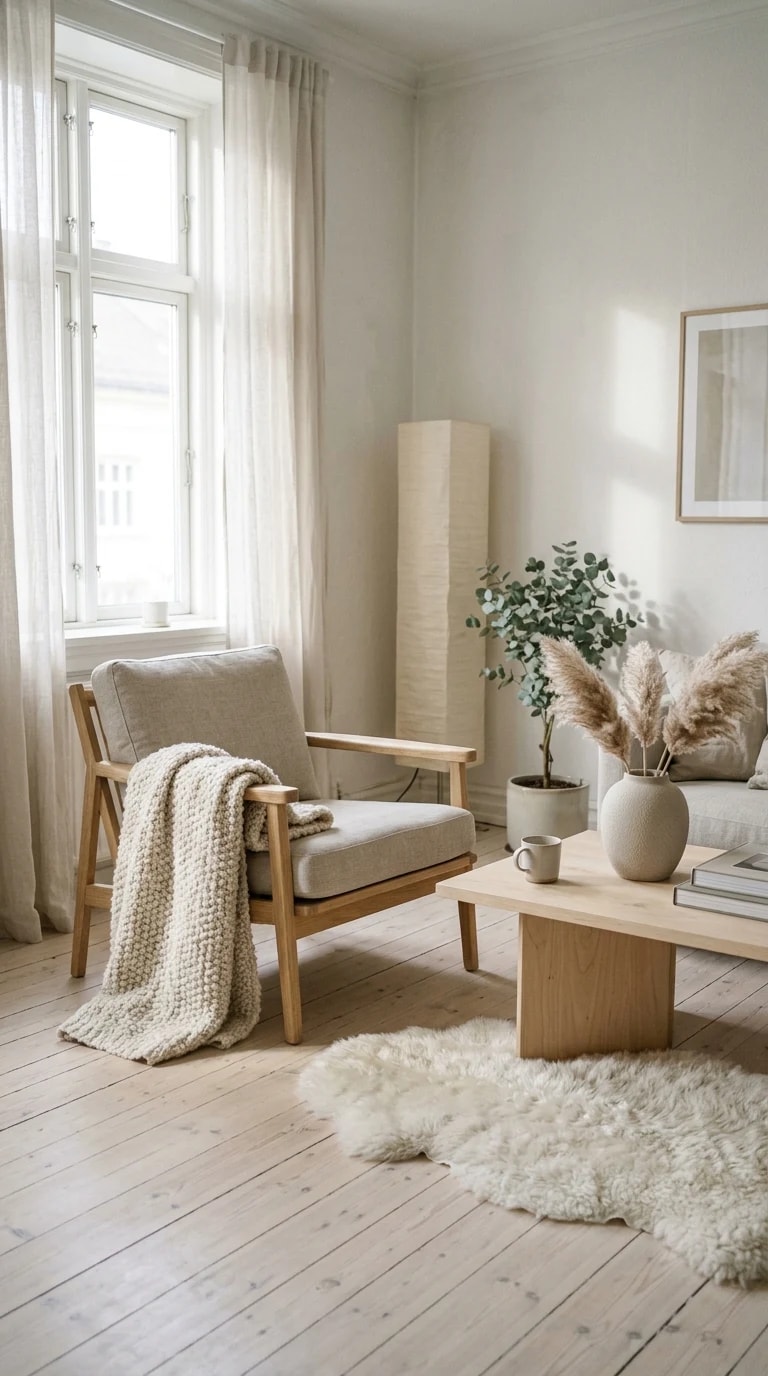
There is a particular kind of quiet that only certain rooms manage to hold, and this corner has it. A pale wood armchair, a knit throw pooled over one arm, a low table with a single mug and a fan of dried pampas grass. Nothing here is expensive-looking in a loud way, and nothing is shouting for attention. That restraint is the whole point. Aesthetic home design works best when it stops behaving like decoration and starts behaving like atmosphere, arranging a small number of honest materials so that the room feels finished without feeling full.
The palette does most of the heavy lifting. Creams, warm beiges, and light oak sit close enough to each other that the eye reads them as one continuous tone, while a muted green from the potted plant gives the composition a place to rest. This is the difference between a neutral room and a beige room: neutrals are layered, with undertones that shift from cool shadow to honeyed light, while beige alone flattens everything into a showroom. Choosing a tight family of warm tones and then varying their depth gives a space dimension that paint chips alone can never predict.
Texture is the real ornament. The chunky knit against smooth wood, the sheepskin rug against pale floorboards, the matte ceramic against the dry, papery heads of the grasses — each contrast makes the others feel more deliberate. When color is quiet, touch takes over, and a room you can almost feel through a photograph is a room that will feel even better in person. Dried stems and a wool throw are not accessories in the decorative sense; they are the elements that soften hard edges and make a corner feel inhabited rather than staged.
Light deserves the same care as furniture. Sheer curtains diffuse the window into a soft, even wash that flatters every surface it touches and keeps shadows gentle rather than graphic. Notice, too, how much is left empty. The tall cabinet stays minimal, the walls stay bare, and the floor around the chair is allowed to breathe. Negative space is not wasted space — it is what lets the eye slow down and what makes the few objects present read as intentional.
If you want this feeling at home, start with one corner rather than the whole room. Place a comfortable chair where the light already falls, add a small table within arm's reach, drape one textured textile, and give the scene a single living thing. Then stop. Let the corner sit for a week before adding anything else. Aesthetic home design is less about acquiring the right pieces than about knowing when a space is already saying enough.