Most minimalist living rooms fail in the same place: they offer nowhere to actually sit down and do nothing. A sofa faces a screen, a dining table faces a wall, and every surface is arranged for looking rather than lingering. The fix is rarely more furniture. It is one chair, placed with intention, angled toward the light.
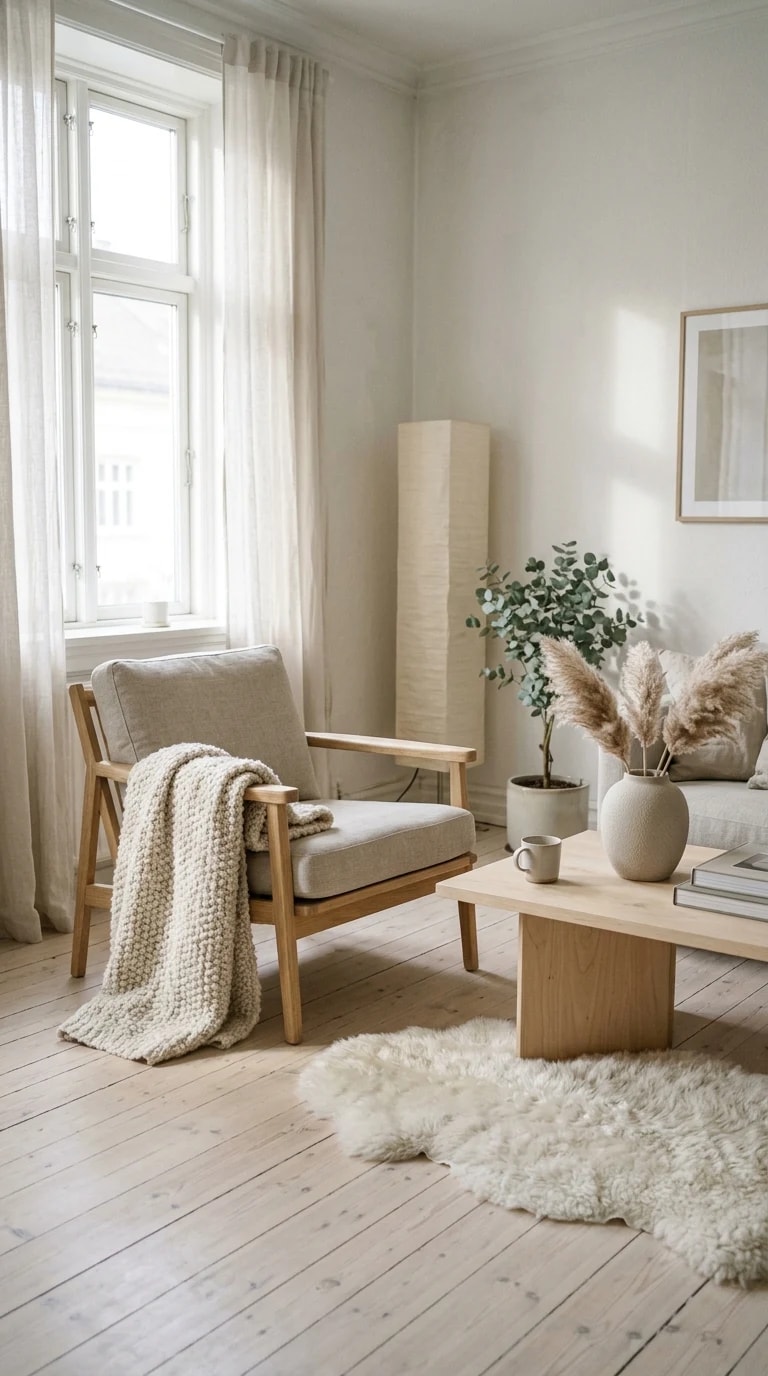
In the corner of this room, a pale wood armchair sits close enough to the window that daylight lands across the seat for most of the afternoon. A chunky cream knit throw is draped over the back rather than folded neatly, which is the small detail that keeps the arrangement from reading as a showroom. Nothing else competes for the spot. The chair has no side table crowding it, no floor lamp leaning over it, no stack of magazines piled beside it. That emptiness is the design decision, not the absence of one. Negative space around a single seat tells the eye where to rest and gives the room its exhale.
Texture does the work that color usually does in warmer, busier rooms. Against walls and floorboards that sit within a few shades of each other, the knit throw, a sheepskin rug, and the loose weave of sheer curtains create depth without adding visual noise. Eucalyptus in a simple pot and dried pampas in a ceramic vase bring in muted green and soft beige, both of which read as neutral at this scale. Pale oak appears three times, in the chair, the slim cabinet, and the low coffee table, and that repetition is what makes the palette feel considered rather than accidental. A framed print, small and hung low, adds the only hard-edged shape in view.
Window light is the real material here. Sheer white curtains diffuse the sun so shadows fall gently instead of cutting hard lines across the floor, and the effect holds through most of the day rather than for one dramatic hour. If you are recreating this, pay attention to which direction the window faces and how the chair is rotated; a seat angled slightly into the room draws you in, while one squared to the glass feels like a waiting area.
Then edit ruthlessly. Keep the mug and the two stacked books, because a quiet corner should look used. Remove everything else that has drifted there, and the room will keep its calm even as the rest of the house gets busy.