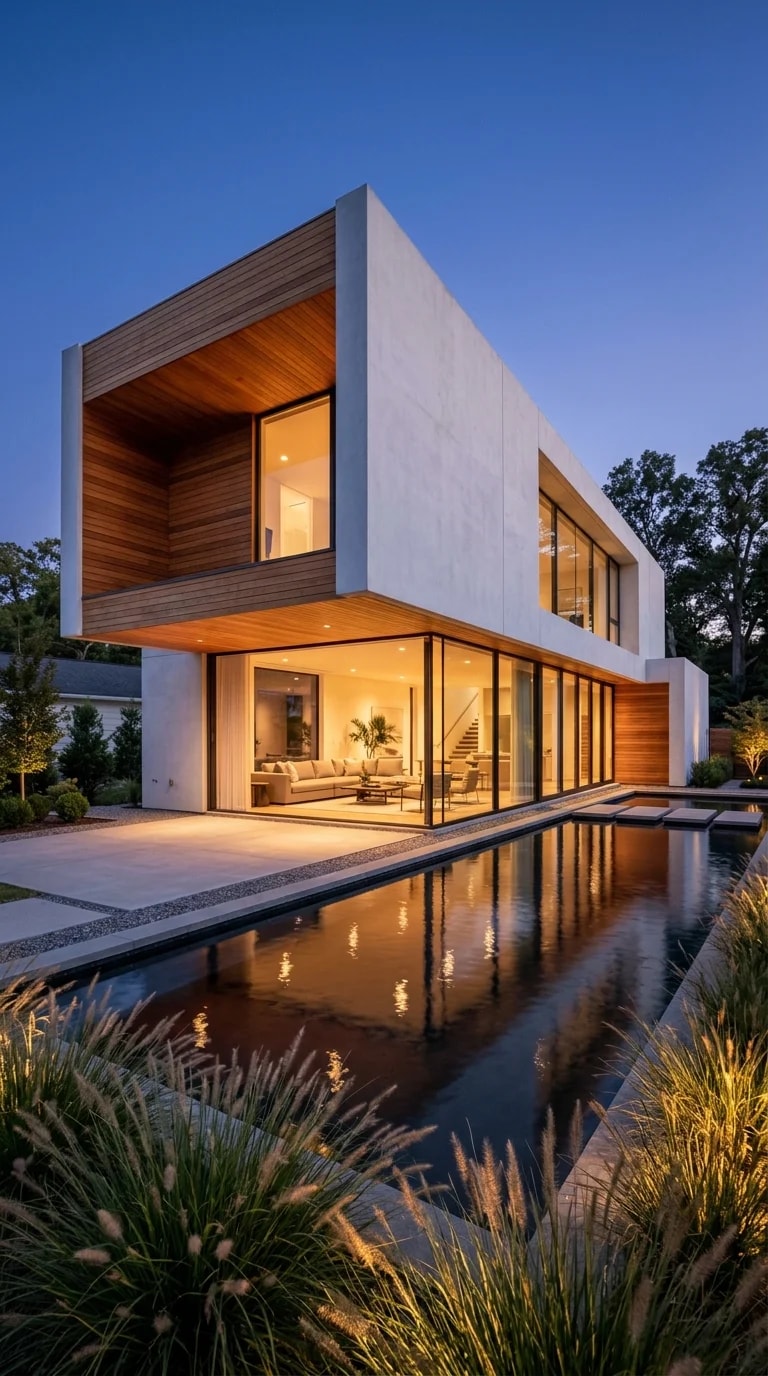
Twilight is the honest hour for architecture. In flat midday sun almost any house looks passable; at dusk, when the sky turns navy and the interior lamps come up, you see exactly what a building is made of. This two-story home passes the test because it never tries to shout. A crisp white upper volume floats above warm wood cladding, floor-to-ceiling glass opens the living room to the street, and a dark reflecting pool holds the whole composition still. Nothing here is loud, and that is precisely why it reads as timeless rather than trendy.
The palette does most of the work. Three materials, three jobs: white plaster bounces the last cool light of the evening, wood returns warmth at eye level, and glass dissolves the wall entirely once the lamps are lit. Designers call this a restrained material board, but the practical version is simpler. When you limit an exterior to a few honest finishes, you stop dating the house to a single decade. Oak, lime render, and glass have been used for centuries and will still look right when the current obsession with a particular gray or a particular tile has passed.
Light is the second material, and it deserves the same drawing time as the millwork. The golden glow spilling onto the terrace is not an accident of lamps left on; it comes from layering. Warm fixtures at low level, a few pools of light on walls, and a dimmer that respects the dark. The reflecting pool earns its keep here, doubling every lit window and stretching the house into the garden. Water also does something no landscape lighting can: it moves, so the reflection breathes, and the façade never looks frozen.
Then there is the framing. Ornamental grasses in the foreground and the long line of the pool work as leading lines, pulling the eye from the garden bed to the front door, softening the hard geometry with movement. A timeless landscape is not a plant list; it is a sequence. You approach, you pause, you arrive. Get that rhythm right and the house will feel calm whether the garden is three years old or thirty.
Timelessness, in the end, is not a style you buy. It is the discipline to choose fewer elements, place them carefully, and light them well. Contrast cool with warm, solid with transparent, architecture with planting. Do that and the house at dusk will look as composed on its twentieth anniversary as it does tonight.