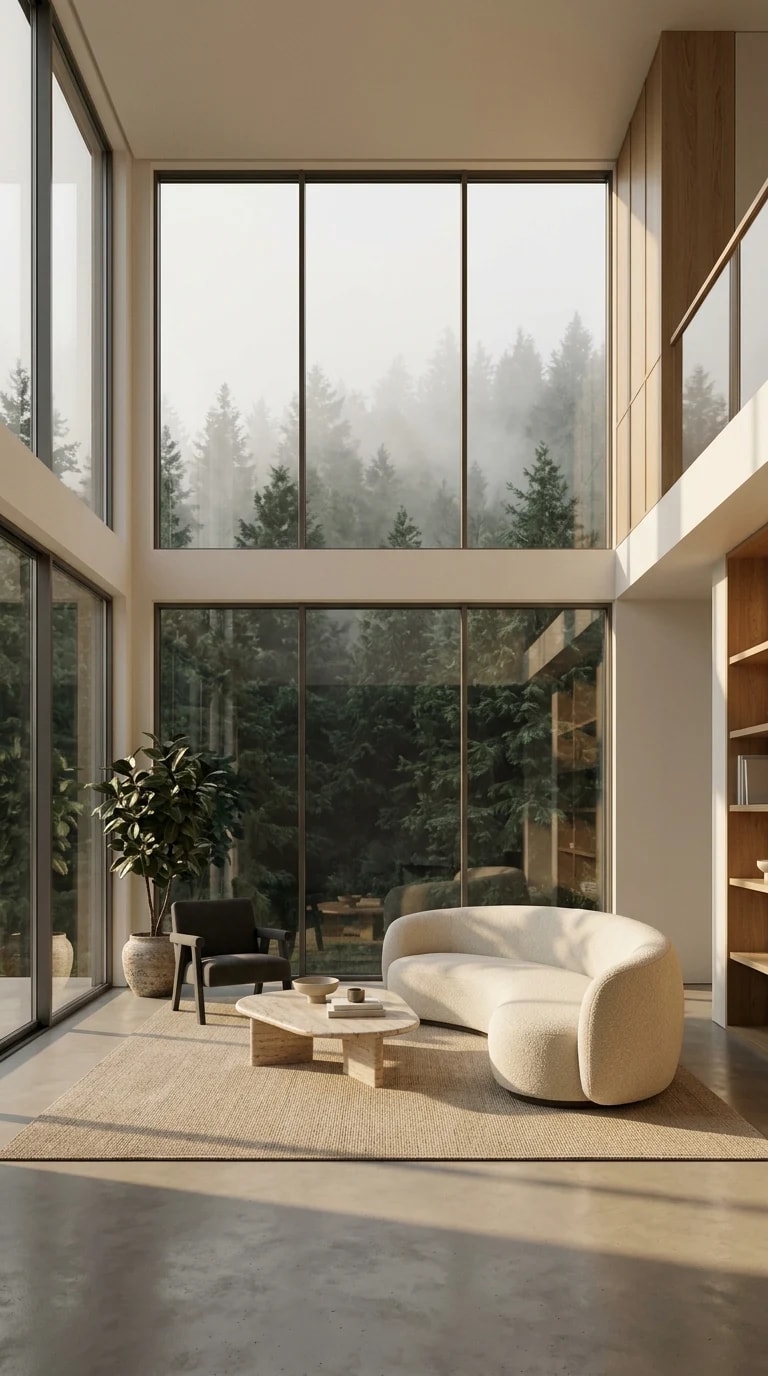
Most living rooms ask you to look out. This one asks you to look up. The glass here runs a full two storeys, from the pale concrete slab to a shadowed ceiling line, which means the view is not a hedge or a lawn but a bank of evergreens rising past the mezzanine and vanishing into fog. Sitting on the curved boucle sofa, you are roughly at the level of the understory; from the mezzanine rail above, you are level with branches. That shift in altitude, available within a single room, is the quiet luxury a wide, horizontal window can never deliver.
Vertical glass changes the quality of light as much as the quantity. A tall opening gathers sky light from above and bounces it deep into the plan, so the floor stays softly lit even under overcast skies, while a low sun cuts a warm patch across the concrete in the afternoon. The engineering matters: specify laminated low-e glazing to manage solar gain, keep mullion profiles slim so the frame reads as a pencil line rather than a wall, and pull the reveal back a few centimetres so the glass sits in shadow. Deep jambs make a tall window feel carved rather than installed, and they soften the transition between warm interior and cool forest.
A room this tall needs furniture that knows its place. The instinct is to fill the vertical volume, but the better move is to keep the bottom third almost silent: a low sofa with a gentle curve, a light-wood coffee table holding a few bowls, a woven tan rug, concrete underfoot. Everything hugs the floor, so the architecture can do the drama above. One dark accent chair and one leafy plant add weight and a hint of green without competing with the trees outside. Wood built-ins along the side wall warm the palette and give the eye somewhere to land that is not the weather.
Then there is the practical pleasure of a room that behaves well in winter. Radiant floors keep the slab comfortable where cold glass would otherwise create a downdraft, and a mezzanine edge becomes a useful perch for reading, storage, or simply watching the fog move. At night, tall glass turns into a mirror, so keep exterior lighting low and warm and let the reflections double the room. Clean the panes twice a year, inside and out; nothing undoes a forest view faster than a hazy film of dust. Do those small things and the height stops being a spectacle and becomes a habit, something you notice only when you sit down, look up, and realise the trees have been keeping you company all along.