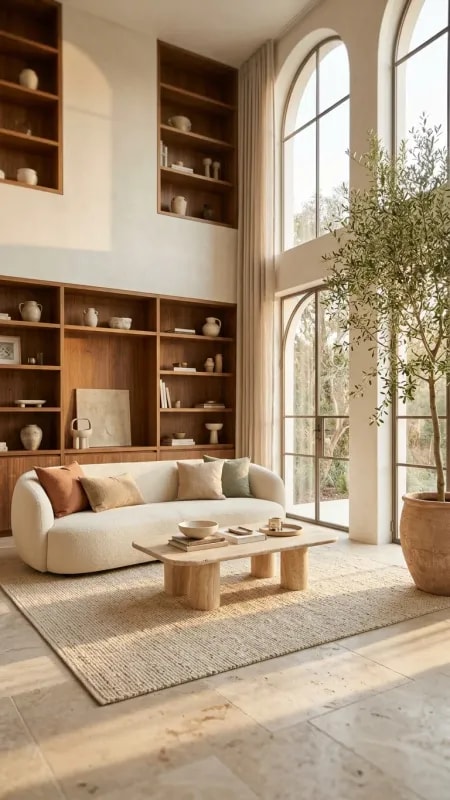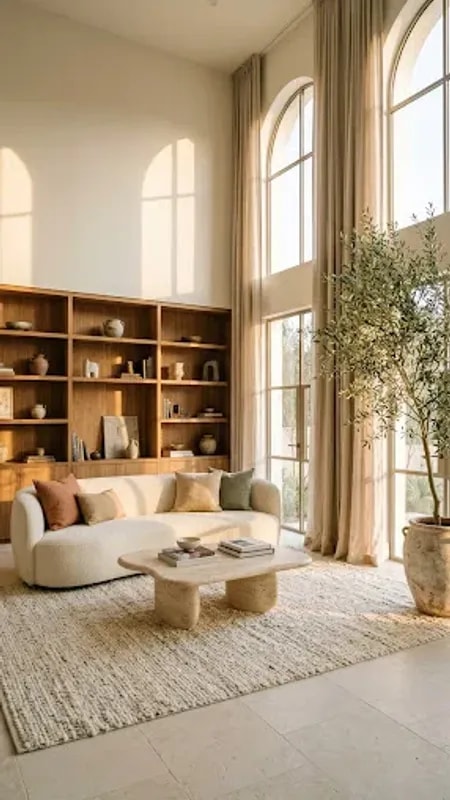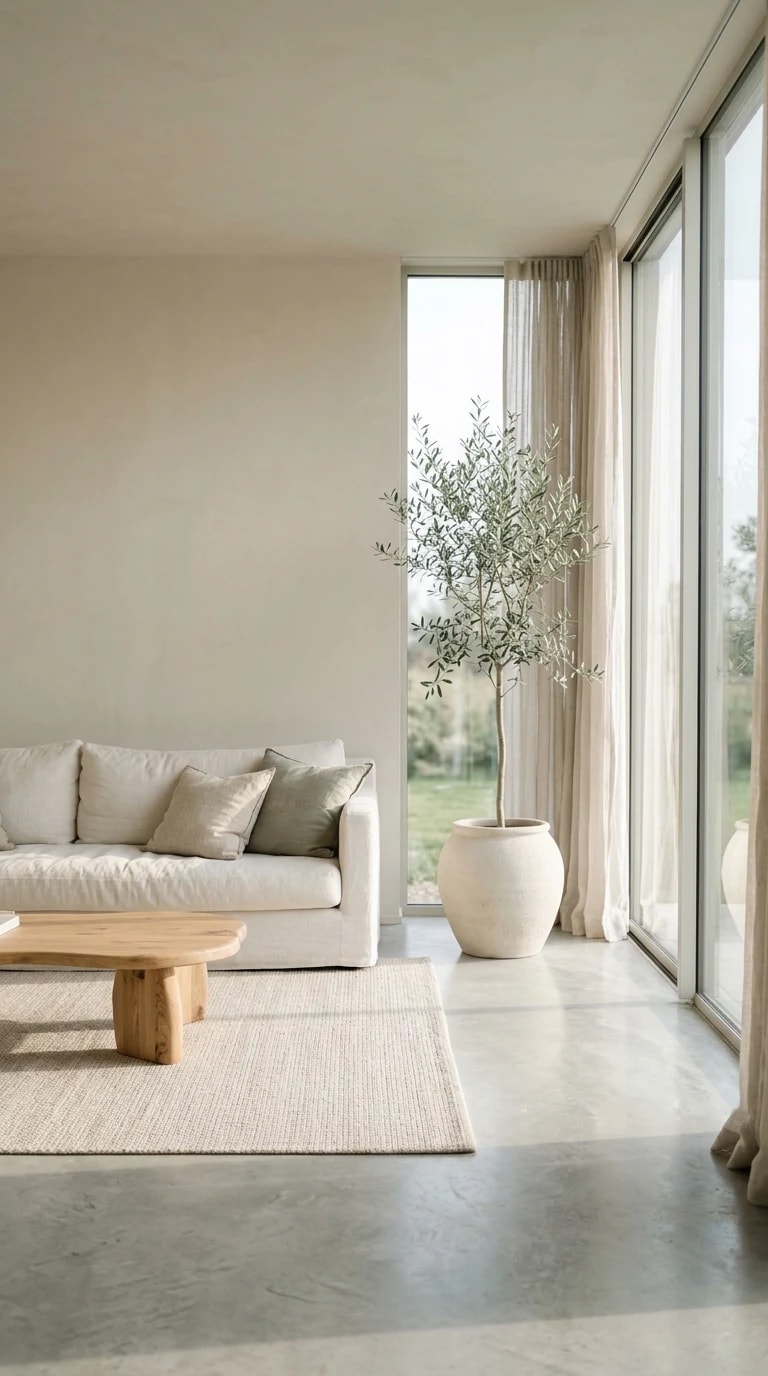
There is a particular moment in a well-made room when your shoulders drop before you have consciously decided to relax. This living room is built entirely around that moment. Nothing in it is tall, glossy, or shouting for attention. The sofa sits close to the floor in a soft off-white, its cushions slightly rumpled in the way that suggests someone actually uses it. Beside it, a coffee table of pale, chunky wood holds an organic silhouette that looks less carved than found. Together they pull the eye downward, and the effect is physical: the ceiling feels higher, the room feels wider, and the body starts negotiating with gravity.
The palette does most of the quiet work. Creams and warm beiges meet the honeyed tone of the wood and the cool grey of polished concrete, with one muted green interrupting the whole arrangement. That green matters more than its size suggests. A tall olive tree in a rounded white ceramic pot gives the composition a vertical beat, a living element that softens the strictness of the architecture and reminds you the room is not a showroom. One plant, generously scaled, will always read better than five small ones scattered along a sill.
Light here is filtered rather than direct. Sheer beige curtains hang from the ceiling to the floor, turning hard afternoon sun into something closer to mist and letting the room glow instead of glare. Textiles pick up that softness: the rug's nubby cream pile, the linen blend of the curtain, the brushed cotton of the cushions. Japandi works best when the textures are honest and slightly imperfect, because that is what keeps minimalism from turning cold. Smooth concrete beside a nubby rug, polished wood beside slubby linen — the contrast is what your hand wants to touch.
Restraint in the layout is just as deliberate. There is one seating group, one table, one plant, one rug. No gallery wall, no stack of coffee-table books competing for attention. The space between the wall and the glass is treated as an object in itself, wide enough to walk through and generous enough to make the room feel unhurried. If you are borrowing this approach, resist the urge to fill the gap. Empty floor is not wasted floor; it is the thing that makes the sofa look inviting and the table look considered.
What results is a room that behaves like a long exhale. Sitting there, with the olive leaves moving slightly against the light, you are not being entertained by the decor — you are being released by it. That is the real promise of this style: not a photograph-perfect interior, but a space that lets you put your cup down, lean back, and stop performing for a while.