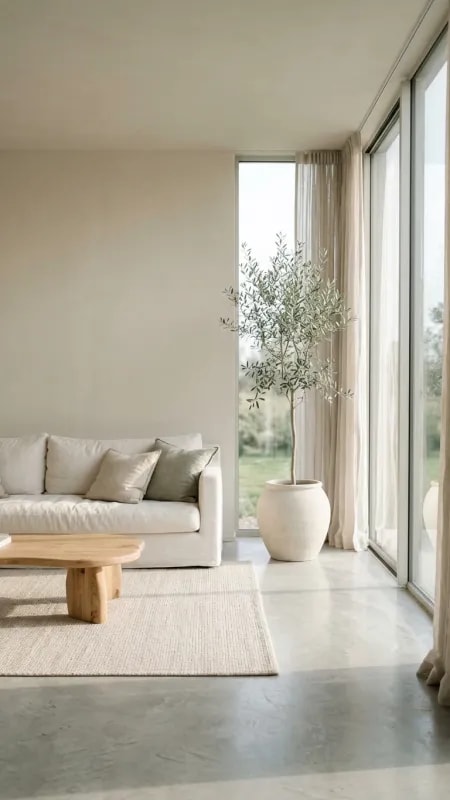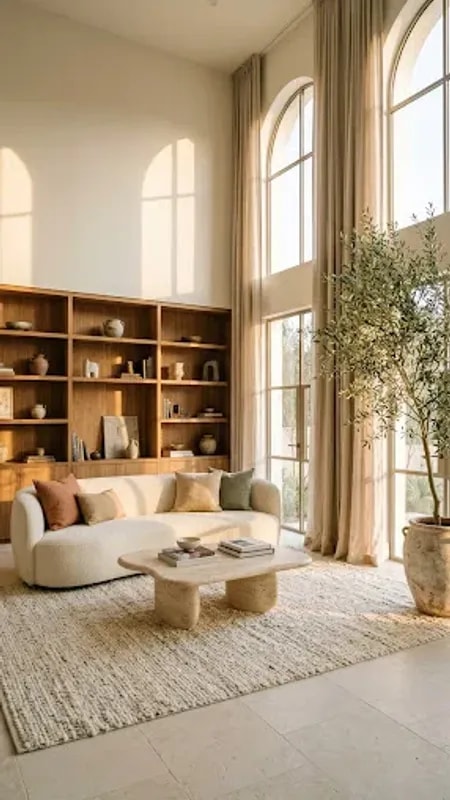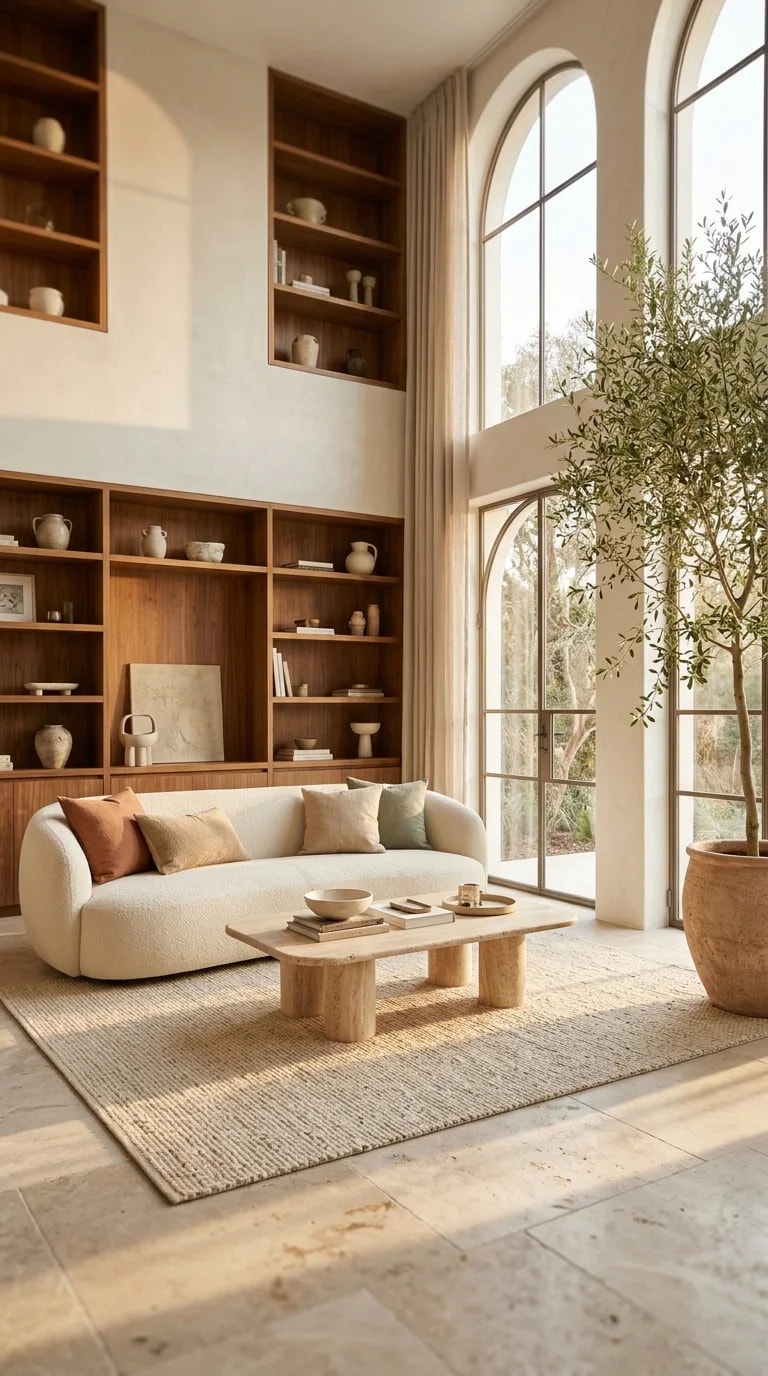
The most expensive thing in this room is something nobody bought: the height. Arched windows running nearly floor to ceiling, a wall of built-in shelving that draws the eye upward, and sunlight that travels across the floor in long angles by mid-afternoon. Architecture like that costs a fortune to build and nothing to keep. The trick is resisting the urge to fill all that air with furniture, and instead spending a modest budget on the few materials that make tall, bright spaces feel inhabited rather than echoing.
Wood is the first place to put money, and the second place to save it. The honey-toned shelving here reads custom, but the same effect comes from plain pine boards stained warm and mounted on simple brackets, or a pair of secondhand bookcases pushed together and trimmed out. For the coffee table, skip the designer chunky slab and look for a low, thick-legged table at estate sales and salvage yards; a butcher-block top sanded and oiled looks just as solid. One rule: keep every wood tone within a family. Cream oak, honey pine and walnut can live together, but orange-red cherry next to grey ash will fight.
Textiles soften the vertical drama. Curtains should be hung close to the ceiling and long enough to break gently on the floor, which adds height rather than cutting it off. A linen-blend panel in oatmeal does the job at a fraction of custom drapery prices, and two panels per window is enough when the windows are this wide. Underfoot, go bigger than feels reasonable with a textured woven rug in a warm neutral, then add color in small doses: a rust cushion, a sage one, a nubby throw over the sofa arm. A curved sofa is lovely, but a straight one in cream with a good slipcover gets you ninety percent of the calm.
Finally, greenery and ceramics carry the personality. A single olive tree in a terracotta pot is worth more visually than five small plants scattered around, and it needs nothing but light and restraint. Fill the shelves slowly, with pieces you actually use: stacked books, hand-thrown mugs, a few framed prints leaning rather than hung. Mismatched shapes read as collected rather than bought-in-bulk, which is exactly the look that makes an affordable room feel considered.